

Finding China Best Dinosaur Fossils Suppliers for Global Buyers requires more than comparing photographs and prices. It demands careful attention to provenance, preparation quality, documentation, and professional conduct. Reputable suppliers should explain where each specimen was found, how it was prepared, and whether its trade is legally permitted. Clear records matter.
Experienced buyers often inspect fossil surfaces, restoration areas, matrix details, and mounting methods. A well-prepared specimen should show consistent texture, stable structure, and honest disclosure of repairs. Small details reveal much. Uneven coloration may indicate restoration. Modern filler can hide damage if the seller is not transparent. Independent specialists, university researchers, or recognized museums can provide valuable opinions before purchase.
Legal compliance must remain central. Dinosaur Fossils may be subject to national heritage laws, export controls, customs requirements, and ownership restrictions. A responsible Chinese supplier should provide lawful provenance records and support appropriate documentation. Buyers should confirm import rules with their own authorities before arranging transport. Not every attractive specimen is suitable for international trade. That is an important limitation.
This guide introduces practical ways to evaluate Chinese suppliers, communicate technical expectations, and reduce avoidable sourcing risks. It also considers packaging, insurance, shipping conditions, and after-sales support. The market is not perfectly consistent. Some listings lack sufficient evidence. Therefore, careful verification remains essential for museums, universities, collectors, and commercial buyers seeking credible, ethically sourced specimens.
China’s dinosaur record spans roughly 230 to 66 million years, from the Late Triassic to the Cretaceous extinction. Its fossil landscapes are highly varied. Sichuan preserves important Jurassic bone beds, while Liaoning is known for delicate feathered dinosaurs and other exceptional fossils. Inner Mongolia and Xinjiang also contain valuable Cretaceous evidence, including eggs, footprints, and fragmented skeletons.
This geological range shapes China’s supplier landscape. Reliable suppliers may work with museums, universities, licensed excavation teams, or certified fossil workshops. Their strongest evidence includes locality data, preparation records, expert identification, and clear ownership documents. In practice, global buyers should ask whether an item is an original fossil, a legally traded specimen, or a scientific replica. A catalogue photograph can mislead.
Documentation matters more than attractive packaging. Buyers should check export permissions, customs requirements, invoices, and chain-of-custody records before purchasing. Some Chinese fossils have restrictions because they support national scientific research or cultural heritage protection. A professional supplier will explain these limits without pressure. Red flags include vague origins, unusually low prices, missing preparation notes, and claims of “complete” skeletons without examination reports. Even experienced buyers can misjudge restoration. That deserves reflection.

China’s 230–66 Million-Year Dinosaur Fossil Record and Supplier Landscape
This chart presents the approximate geological span of China’s dinosaur fossil record, from the Late Triassic to the end of the Cretaceous. The age ranges follow internationally recognized geological boundaries: Late Triassic 230–201 million years ago, Jurassic 201–145 million years ago, and Cretaceous 145–66 million years ago. For global buyers, supplier evaluation should also include documented provenance, export compliance, conservation status, and independent authenticity verification.
Data basis: International Chronostratigraphic Chart age boundaries and the documented 230–66 Ma range of dinosaur-bearing formations in China.
China Best Dinosaur Fossils Suppliers for Global Buyers
Chinese fossil suppliers generally fall into three practical categories: authentic specimens, replicas, and fossil parts. Authentic specimens should include clear locality records, preparation details, and lawful export documentation. Ask whether the piece is complete, restored, or assembled from several fragments. A polished surface can hide repairs. Look closely.
Replicas are made from resin, plaster, or carefully molded composites. Reliable suppliers should identify the material, production method, scale, and weight. Compare the texture with reference photographs. Real bone often shows irregular pores, mineral variation, and natural cracks. Replicas may look perfect, which is sometimes the warning sign. A detailed invoice should state “replica” clearly.
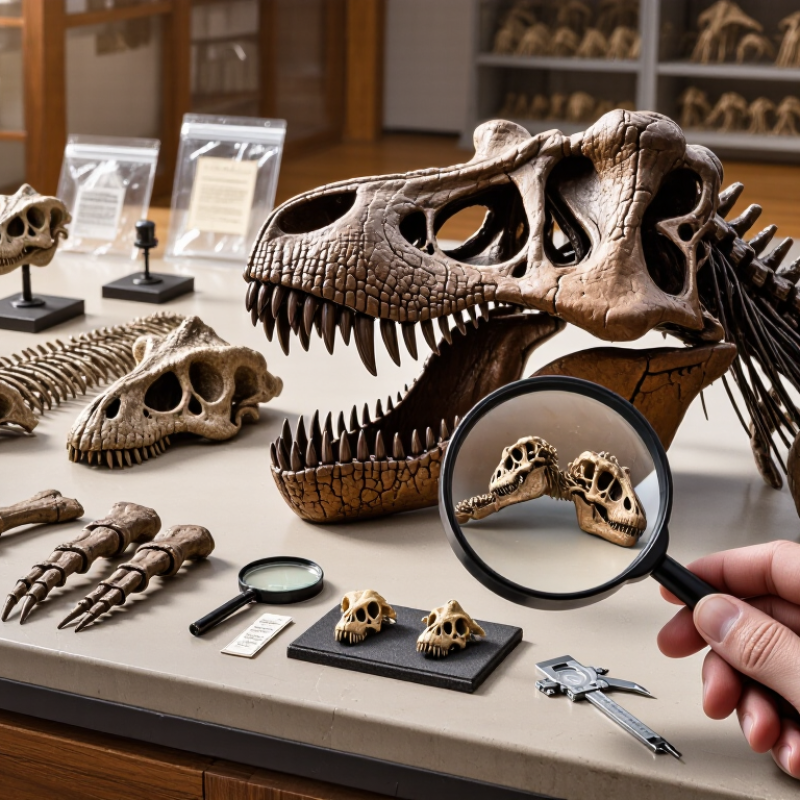
Fossil parts include teeth, vertebrae, claws, plates, and small fragments. Parts can be authentic, restored, or cast, so classification requires careful wording. Request close images of edges, break surfaces, mounting holes, and adhesive marks. Suppliers with professional experience can explain preparation without making exaggerated claims. Independent review from a museum specialist or qualified paleontologist adds useful evidence.
Some listings remain unclear, even after several questions. That uncertainty matters. Buyers should verify ownership history, customs requirements, and destination-country rules before payment. Certificates are helpful, but they are not automatically proof of authenticity. I have found that patient questioning reveals more than impressive descriptions. A trustworthy supplier accepts scrutiny, admits limitations, and corrects inaccurate information when new evidence appears.
| Supplier Classification | Material Status | Typical Products | Authenticity and Condition Indicators | Documents and Verification to Request | Typical Buyer Use | Key Purchasing Risks |
|---|---|---|---|---|---|---|
| Authentic Specimen Suppliers | Natural fossil material that may be complete, partially complete, restored, or professionally prepared. |
|
|
| Museums, universities, research collections, educational displays, and high-value private collections. | Unclear provenance, undisclosed restoration, inaccurate species identification, and restrictions on collection or export. |
| Research-Grade Authentic Suppliers | Authentic fossil material supplied with stronger scientific documentation and collection records. |
| Documentation normally provides locality information at an appropriate level, geological formation, estimated age, dimensions, and preparation history. |
| Scientific study, teaching collections, exhibitions, and documented institutional procurement. | Scientific claims may exceed available evidence; locality data can be incomplete; cross-border transfer may require specialist legal review. |
| Replica and Cast Suppliers | Man-made reproductions produced from molds, scans, photographs, or reconstructed references; no original fossil content is implied. |
| Surface texture, coloration, weight, and construction are consistent with the stated casting or fabrication material. Artificial parts should be clearly disclosed. |
| Museums, visitor centers, schools, themed interiors, exhibitions, film production, and retail decoration. | Replica items being marketed as genuine fossils, inaccurate dimensions, fragile joins, color fading, and transport damage. |
| Authentic Fossil Parts Suppliers | Genuine fossil fragments or individual elements that may be incomplete, repaired, stabilized, or separated from a larger specimen. |
| The listing should distinguish natural fossil material from restoration, composite assembly, modern filler, and attached matrix. |
| Comparative collections, educational samples, scientific reference sets, and small display pieces. | Composite specimens, modern replacements, excessive restoration, misleading species labels, and insufficient legal documentation. |
| Preparation and Restoration Specialists | Suppliers that clean, stabilize, repair, mount, or reconstruct fossil material; the service may be applied to authentic specimens or replicas. |
| Quality depends on reversibility, compatibility of adhesives and fillers, structural stability, and accurate disclosure of intervention areas. |
| Collectors, museums, laboratories, galleries, and buyers who already possess legally acquired material. | Over-cleaning, irreversible repairs, hidden reconstruction, structural weakness, and damage caused by unsuitable packing or mounting. |
| Decorative and Educational Model Suppliers | Non-fossil products manufactured for visual education or decoration, usually using resin, plaster, fiberglass, metal, or 3D-printed materials. |
| Product descriptions should identify the material, scale, intended environment, surface finish, and whether the item is suitable for outdoor use. |
| Schools, retail stores, exhibitions, science centers, restaurants, parks, and interior design projects. | Misleading product titles, inconsistent color or scale, inadequate packaging, and unsupported claims about scientific accuracy. |
| Mixed-Inventory Suppliers | Suppliers offering authentic fossils, replicas, restored specimens, and fossil parts in the same catalogue. | A broad product range, often including small educational specimens, display replicas, prepared pieces, and custom orders. | Each item must be assessed separately. Catalogue categories should not be treated as proof of authenticity. |
| Importers seeking multiple product types or complete exhibition packages from one procurement source. | Category confusion, inconsistent documentation, substitution of stock items, and different legal treatment for different products. |
| Custom Fabrication Suppliers | Made-to-order replicas, reconstructions, mounts, display cases, and educational installations based on supplied specifications. |
| Accuracy depends on the reference source, approved drawings, scale, fabrication method, and final quality-control process. |
| Large exhibitions, institutional projects, educational installations, and themed commercial spaces. | Scope changes, unapproved substitutions, inaccurate anatomy, delayed production, oversized freight, and installation difficulties. |
Legal provenance should guide every fossil purchase from China. China’s Regulation on the Protection of Paleontological Fossils treats important fossils as protected scientific resources. Collection, transfer, appraisal, and export may require official review. Export paperwork can include provenance records, expert identification, permits, invoices, and customs declarations. Requirements may vary by fossil category and location.
CITES does not automatically regulate dinosaur fossils. Its rules mainly cover specimens from listed living species, not ordinary fossilized remains. However, importing countries may apply stricter heritage, customs, or scientific-resource laws. The CITES Trade Database contains more than 25 million reported records, according to the CITES Secretariat’s database overview. That scale shows why document checks matter. A CITES reference is not a substitute for Chinese export approval.
Buyers should request a continuous chain of custody. Check the excavation location, legal ownership, appraisal report, export authorization, and destination-country requirements. Keep photographs of the specimen and its sealed packaging. A clean invoice alone proves little. This is where inexperienced buyers often misjudge risk.
Even careful screening can miss an incomplete archive, so independent review remains sensible.
Sources: CITES Trade Database overview; CITES Secretariat Annual Report 2023; China’s Regulation on the Protection of Paleontological Fossils.
A serious supplier review should begin with a 300-plus-species evaluation matrix. It should record species, formation, locality, geological age, specimen dimensions, and preparation history. The Paleobiology Database offers a useful reference for checking taxonomy and fossil occurrences. However, database records do not prove ownership or legal export rights.
Geological evidence should match the specimen. Look for consistent formation names, stratigraphic horizons, field photographs, and collection numbers. A label saying “Jurassic” is not enough. Records matter. Independent review is better. A 300-species list can still hide weak provenance, especially when descriptions repeat identical wording.
Export documentation deserves equal attention. Request invoices, packing lists, origin statements, acquisition records, and the proposed Harmonized System classification. The World Customs Organization places collectors’ pieces within heading 9705, but national customs treatment can differ. The UNESCO 1970 Convention also supports controls against illicit cultural-property trade, so buyers should verify origin-country rules before payment. The World Bank’s 2023 Logistics Performance Index evaluates customs, infrastructure, shipments, and tracking, while UNCTAD’s 2023 maritime report states that over 80 percent of global merchandise trade moves by sea. These figures explain why documentation and shipment visibility matter. Still, reports cannot replace careful judgment. No spreadsheet replaces judgment.
China’s experienced dinosaur fossil suppliers should provide clear provenance before discussing price. Ask for the specimen’s discovery location, excavation history, and legal ownership records. A reliable file may include scale photographs, preparation notes, mineral descriptions, and an independent identification report. Check the fossil against its paperwork. Small mismatches matter.
Authentication should be practical, not theatrical. Examine repaired seams, filled cracks, unusual color, and artificial surface shine. Request ultraviolet images when restoration is suspected. Specialist testing, including microscopy or CT scanning, can reveal hidden joins, but no single test proves everything. I still treat attractive claims cautiously. A polished surface can mislead. Seek review from a qualified paleontology professional before payment.
Conservation begins with stable handling. Use acid-free supports, soft foam, and a rigid custom crate. Keep the specimen away from sudden humidity changes, direct sunlight, and vibration. The shipping package should include condition photographs taken before sealing. Export documents, customs declarations, permits, and ownership records must match exactly. Requirements can differ by origin, destination, and fossil category. Confirm them with relevant authorities. Insurance should cover the declared market value, packing, transit risks, and possible restoration costs. Ask whether coverage includes concealed damage discovered after delivery. A short inspection window is useful. Even careful packing can fail when a crate meets rough handling or damp storage.

© Copyright 2025 | CONTAINERED – SHIPPING CONTAINER HOMES IN MELBOURNE