

Choosing a Terrace Awning is not simply a matter of picking an attractive fabric. Global buyers must consider climate, wall construction, wind exposure, drainage, installation skills, and long-term maintenance. A sunny balcony in Dubai needs different protection from a rainy terrace in Manchester. Small details matter, including cassette size, projection depth, motor voltage, and the angle of the mounting surface.
Michael Gerling, a longtime sun-shading technology expert, puts the principle plainly: “Good shading begins with the building, not the fabric.” His view reflects a practical truth. A beautiful awning can still perform poorly if the brackets, fixings, or water management are unsuitable. That mistake is expensive.
This guide presents ten buying tips for international customers. It examines fabric performance, frame materials, corrosion resistance, automation, local weather, packaging, warranty terms, and installation support. Each point connects product specifications with real purchasing conditions. A coastal home may need marine-grade protection. A commercial terrace may require stronger hardware and easier servicing. A compact urban balcony may sacrifice projection for clearance.
Check the measurements twice.
Some recommendations will not suit every project. Budget, architecture, and local workmanship can change the best decision. Buyers should question impressive claims, request technical documents, and confirm compatibility before payment. In practice, the cheapest Terrace Awning is rarely the least expensive choice over several seasons. Reliable shade comes from balanced decisions, not one impressive feature.
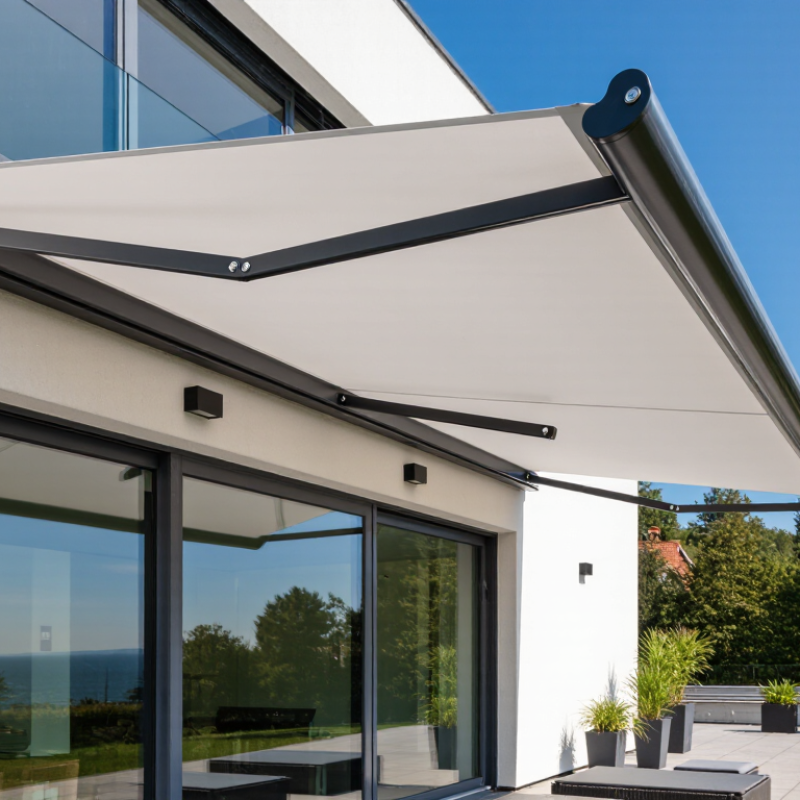
A terrace awning should match real outdoor habits, not just attractive photos. Measure the terrace width, projection, mounting height, and nearby doors before requesting quotations. Note when sunlight reaches the seating area. West-facing terraces often receive intense afternoon heat.
The U.S. Department of Energy reports that window awnings can reduce solar heat gain by up to 77% on west-facing windows and 65% on south-facing windows. Terrace results vary, but the orientation remains useful evidence.
Consider rain, wind, snow, dust, and salt air. Wind changes everything. A coastal terrace may need corrosion-resistant hardware and quick retraction. A rainy location needs fabric with reliable water resistance and a slope that directs water away from walls. Check local wind requirements and installation rules.
EN 13561 provides performance requirements for external blinds and awnings, including wind resistance. Ask suppliers for test classifications, not vague claims.
Control choices should reflect daily use. Manual operation can suit a small terrace, while motorized control helps with wide coverings or limited mobility.
Smart sensors sound convenient, but sensors need correct placement and maintenance. I once underestimated evening glare; the awning blocked heat but not low sunlight. Recheck the fabric color, openness, drainage, and nighttime lighting. A quiet compromise may be better than a perfect specification.

Choosing a terrace awning starts with climate, not appearance. The IEA’s 2023 Global Status Report says buildings use about 30% of global final energy. External shading can reduce cooling demand before heat reaches the glass. The U.S. Department of Energy reports that awnings may cut solar heat gain by up to 65% on south-facing windows and 77% on west-facing windows. Retractable awnings suit changing weather, while fixed canopies offer steadier protection. For coastal terraces, powder-coated aluminum frames and solution-dyed acrylic fabrics usually deserve closer inspection than untreated steel or basic polyester.
Tip: Compare fabric weight, UV resistance, water repellency, and colorfastness. A dark fabric may look richer, but it can absorb more heat. I still would not choose color from a small screen sample. Request a physical swatch.
Measure the full terrace width, then check the required projection and mounting height. Leave door clearance and consider the sun’s lower winter angle. A narrow awning may shade the seating area but miss the glass. Operating systems also change daily convenience. A manual crank costs less and works during power cuts. Motorized systems are easier for wide awnings. Wind, sun, and rain sensors add control, but they also add failure points and maintenance. Look for documented wind ratings and installation guidance aligned with EN 13561 or equivalent regional standards.
Tip: Test the awning while standing beneath it. Watch the joints, fabric tension, drainage, and closing speed. Small installation errors become obvious later.
Measure the installation area before comparing terrace awning prices. Record the wall width, usable height, projection, and opening direction in millimetres. Measure at least three points because masonry is rarely perfectly level. A 20 mm difference can affect bracket alignment and fabric tension. Check doors, windows, gutters, lights, railings, and ventilation paths. Leave enough clearance for moving parts and safe drainage.
Structural capacity matters more than appearance. Identify the wall material first: reinforced concrete, brick, blockwork, timber, or insulated cladding. Each surface needs different anchors and fixing depths. The 2024 International Building Code and ASCE 7-22 require designs to consider local wind and snow loads. Coastal or high-altitude sites may need stronger connections. Ask a qualified installer to verify pull-out resistance, especially above large doors. Do not assume a solid-looking façade is load-bearing.
Energy performance also deserves attention. The U.S. Department of Energy reports that windows can account for roughly 25% to 30% of residential heating and cooling energy use. Correctly positioned shading may reduce solar gain, but results depend on orientation, fabric openness, and ventilation. Field checks often reveal overlooked problems, such as hidden pipes or weak render. My own planning habit would be more cautious: photograph the wall, mark every obstruction, and confirm the final load calculation before ordering. Mistakes here are expensive.
Climate resistance should guide every purchase. The WMO reported that 2023 was about 1.45°C above the pre-industrial average. Stronger heat, rain, and storms can shorten fabric life. Check UV resistance, waterproofing, corrosion protection, and drainage design. Ask for tested wind-resistance data, not vague claims. European standard EN 13561 classifies external blinds and awnings by wind resistance. However, its rating may not match local building conditions. That gap matters.
Measure the terrace, wall strength, fixing depth, and awning projection. A large projection catches more wind. In coastal areas, specify corrosion-resistant fasteners and inspect salt deposits often. In snowy regions, confirm whether the structure is designed for snow loads or must remain retracted. The NOAA 2023 report recorded 28 separate billion-dollar weather and climate disasters in the United States. That figure is not a universal design rule, but it shows why old assumptions deserve review.
Safety standards and local regulations require equal attention. Request installation instructions, load-test documents, electrical safety files, and emergency operating procedures. Check requirements for façade alterations, fire separation, drainage, outdoor wiring, and wind exposure. Some councils require permits, especially for commercial terraces or heritage buildings. Verify the installer’s qualifications and insurance. Keep maintenance access clear. A sensor can reduce risk, but it cannot replace inspection. I would not rely on a beautiful sample alone; fabric color, mounting quality, and local approval can change the real result.
When comparing terrace awning suppliers, request a written specification, not only a price. Check fabric weight, frame treatment, wind rating, drainage design, and replacement-part availability.
The U.S. Department of Energy reports that window awnings can reduce solar heat gain by up to 77% on south-facing windows and 65% on west-facing windows. Ask suppliers to explain whether their design can deliver similar results at your site.
Installation quality affects safety and service life. Confirm who measures the wall, checks its structure, seals fixing points, and removes packaging. A low-cost quote may exclude scaffolding, electrical work, delivery, or local taxes. Request these costs separately.
The International Energy Agency’s 2023 buildings report says buildings represented about 30% of global final energy consumption in 2022. Better shading may support comfort, but savings depend on climate, glass, controls, and user habits.
Read the warranty line by line. Look for different periods covering fabric, motor, frame, finishes, and labor. A five-year component warranty may provide little protection if installation coverage lasts only twelve months. Ask how claims are handled across borders, including response time and spare-part shipping.
I would also request two completed project references in a similar climate. This step feels slow. It often exposes weak after-sales support. Compare the total five-year cost, not the first invoice, and leave room for repairs you cannot yet predict.

© Copyright 2025 | CONTAINERED – SHIPPING CONTAINER HOMES IN MELBOURNE