
Close

Choosing the right foldable shipping container can shape transport costs, warehouse efficiency, and project reliability. Global buyers face many configurations, materials, and operating conditions. A container that works beside a European distribution center may struggle on a humid coastal route.
This guide examines ten practical foldable shipping container types for different cargo and handling needs. Options may include standard dry units, side-opening models, open-top designs, flat racks, and specialized storage systems. Each type brings different benefits. Capacity matters. So do hinges, locking pins, floor strength, tare weight, and folded dimensions. Small details become expensive problems.
Experienced buyers should review drawings, test reports, and supplier records before placing large orders. ISO-related claims should be verified through current certificates, not attractive product photos. Ask how the frame performs after repeated folding. Check corrosion protection, forklift access, stacking limits, and replacement-part availability. A clear inspection plan helps reduce surprises at the port.
No single design fits every route. That is easy to forget. Some buyers focus on purchase price and overlook return logistics. Others select a compact model without measuring loading equipment. Those mistakes are understandable, but avoidable. Reliable sourcing combines technical evaluation, documented quality control, and honest communication with manufacturers. The following ten container types provide a practical starting point, while local transport rules and cargo requirements still need careful confirmation.
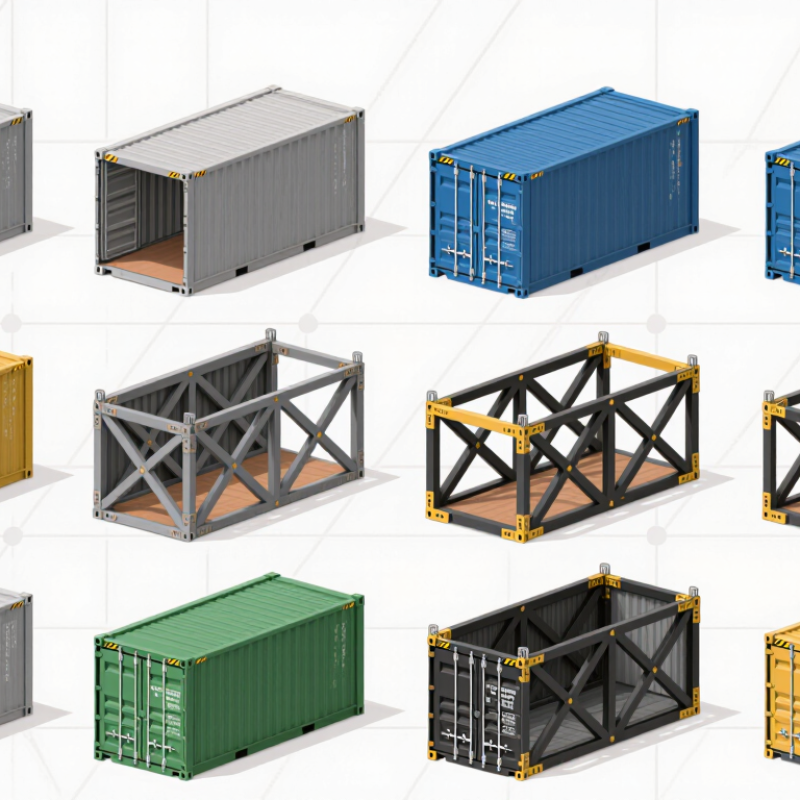
ISO 668 defines the foundation for foldable container buying: 20-foot units measure 6.058 metres long, while 40-foot units measure 12.192 metres. Both are 2.438 metres wide and normally 2.591 metres high externally. A 20-foot box equals one TEU; a 40-foot box equals two. The standard covers dimensions, corner fittings, and tolerances, not every folding mechanism. That distinction matters.
The ten commercial options usually differ by structure and use: side-folding, end-folding, telescopic, collapsible flat-rack, open-top, high-cube, reinforced, ventilated, insulated, and heavy-duty models. Yet only some combine folding hardware with ISO 668 external dimensions. UNCTAD’s Review of Maritime Transport 2024 reports that maritime shipping carries over 80% of global merchandise trade by volume. Compatible corner castings and verified stacking ratings therefore remain practical priorities. A folded unit may save depot space, but its folded height can vary widely. Measure twice. Details matter.
Tips: Confirm the supplier’s ISO 668 dimensional certificate, maximum gross mass, and corner-post rating. Check whether the 40-foot model keeps usable internal length after folding joints are installed. Inspect hinges, locking pins, floor strength, and corrosion protection before purchase. A common mistake is treating “collapsible” as automatically “ship-ready.” It is not. Buyers should also compare local crane limits, road restrictions, and empty-return costs. The cheapest design may create handling delays, and that possibility deserves honest attention.
| No. | Foldable Container Type | Primary Folding Method | ISO 668 Size | Nominal External Dimensions (L × W × H) |
Typical Folded Height | Typical Cargo Application | Key Buyer Consideration |
|---|---|---|---|---|---|---|---|
| 1 | Side-Folding Dry Van | Long side walls fold inward or toward the base | 20 ft / 40 ft | 20 ft: 6.058 × 2.438 × 2.591 m 40 ft: 12.192 × 2.438 × 2.591 m |
Design-dependent; commonly about 0.65–0.85 m per folded unit | General merchandise, packaging materials, and temporary storage | Check seal performance, wall locking, and folded-stack stability |
| 2 | End-Folding Dry Van | End panels and side assemblies fold toward one end | 20 ft / 40 ft | 20 ft: 6.058 × 2.438 × 2.591 m 40 ft: 12.192 × 2.438 × 2.591 m |
Usually about 0.75–1.00 m, depending on hinge design | Seasonal inventory, modular buildings, and project cargo | Confirm door clearance and the required assembly equipment |
| 3 | Collapsible Flat Rack | End walls fold flat onto the reinforced platform | 20 ft / 40 ft | 20 ft: 6.058 × 2.438 × 2.591 m envelope 40 ft: 12.192 × 2.438 × 2.591 m envelope |
Typically about 0.35–0.65 m | Machinery, steel products, vehicles, and oversized cargo | Verify payload, lashing points, concentrated floor load, and stackability |
| 4 | Folding Open-Top Container | Side or end structures fold while the roof remains open | 20 ft / 40 ft | 20 ft: 6.058 × 2.438 × 2.591 m 40 ft: 12.192 × 2.438 × 2.591 m |
Commonly about 0.60–0.90 m | Tall machinery, logs, scrap metal, and bulk cargo loaded from above | Confirm tarp arrangement, cargo height, drainage, and overhead lifting access |
| 5 | Folding Half-Height Container | Low side walls fold inward or onto the base | 20 ft / 40 ft | 20 ft: 6.058 × 2.438 × approximately 1.295 m 40 ft: 12.192 × 2.438 × approximately 1.295 m |
Often about 0.40–0.70 m | Dense minerals, stone, scrap, and other heavy low-volume cargo | Confirm that the lower internal height meets the cargo and handling requirements |
| 6 | Folding Refrigerated Container | Insulated panels fold into a compact transport configuration | 20 ft / 40 ft | 20 ft: 6.058 × 2.438 × 2.591 m 40 ft: 12.192 × 2.438 × 2.591 m |
Product-specific; commonly about 0.80–1.20 m | Temperature-sensitive goods and short-term cold-chain storage | Evaluate thermal performance, power supply, refrigeration certification, and condensation control |
| 7 | Folding Tank Container Frame | The ISO frame folds; the tank vessel is removable or protected within the frame | 20 ft frame | Approximately 6.058 × 2.438 × 2.591 m | Usually about 0.70–1.00 m for the folded frame | Liquids, powders, and regulated bulk materials | Tank design, pressure rating, hazardous-goods rules, and inspection status are critical |
| 8 | Folding Platform Container | End structures fold down to create a low platform | 20 ft / 40 ft | 20 ft: 6.058 × 2.438 × 2.591 m envelope 40 ft: 12.192 × 2.438 × 2.591 m envelope |
Typically about 0.35–0.60 m | Project cargo, construction equipment, pipes, and oversized machinery | Review deck strength, cargo overhang limits, lashing rings, and route restrictions |
| 9 | Folding Side-Door Container | Side doors and wall sections fold to reduce empty return volume | 20 ft / 40 ft | 20 ft: 6.058 × 2.438 × 2.591 m 40 ft: 12.192 × 2.438 × 2.591 m |
Commonly about 0.70–1.00 m | Palletized goods, retail stock, event equipment, and site storage | Check side-door width, forklift access, gasket durability, and floor protection |
| 10 | Folding Modular Accommodation Unit | Floor, wall, and roof panels fold into a transportable module | 20 ft / 40 ft envelope | 20 ft: 6.058 × 2.438 × 2.591 m envelope 40 ft: 12.192 × 2.438 × 2.591 m envelope |
Often about 0.60–1.20 m, depending on fittings | Offices, classrooms, clinics, shelters, and workforce accommodation | Confirm local building codes, insulation, fire safety, utilities, and wind-load requirements |
| Technical note: ISO 668 defines the principal external dimensions and corner-fitting locations for freight containers; it does not prescribe one universal folding mechanism. The 20-foot and 40-foot dimensions shown above are nominal external envelopes. Folded heights, tare weights, payloads, internal dimensions, and certification status vary by construction and should be confirmed in the supplier’s technical drawings and CSC documentation. | |||||||



© Copyright 2025 | CONTAINERED – SHIPPING CONTAINER HOMES IN MELBOURNE